


Page 14 - Demo
P. 14
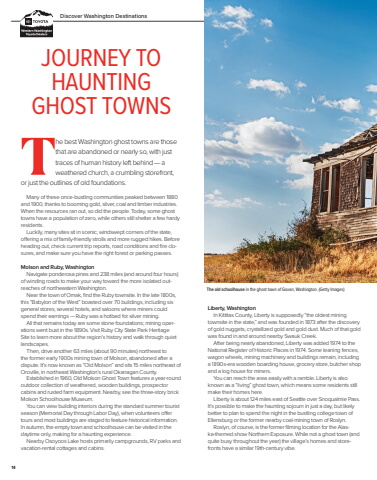
14Discover Washington DestinationsThe best Washington ghost towns are those that are abandoned or nearly so, with just traces of human history left behind %u2014 a weathered church, a crumbling storefront,or just the outlines of old foundations.Many of these once-bustling communities peaked between 1880 and 1900, thanks to booming gold, silver, coal and timber industries. When the resources ran out, so did the people. Today, some ghost towns have a population of zero, while others still shelter a few hardy residents.Luckily, many sites sit in scenic, windswept corners of the state, offering a mix of family-friendly strolls and more rugged hikes. Before heading out, check current trip reports, road conditions and fire closures, and make sure you have the right forest or parking passes.Molson and Ruby, Washington Navigate ponderosa pines and 238 miles (and around four hours) of winding roads to make your way toward the more isolated outreaches of northeastern Washington. Near the town of Omak, find the Ruby townsite. In the late 1800s, this %u201cBabylon of the West%u201d boasted over 70 buildings, including six general stores, several hotels, and saloons where miners could spend their earnings %u2014 Ruby was a hotbed for silver mining. All that remains today are some stone foundations; mining operations went bust in the 1890s. Visit Ruby City State Park Heritage Site to learn more about the region%u2019s history and walk through quiet landscapes. Then, drive another 63 miles (about 90 minutes) northeast to the former early 1900s mining town of Molson, abandoned after a dispute. It%u2019s now known as %u201cOld Molson%u201d and sits 15 miles northeast of Oroville, in northeast Washington%u2019s rural Okanagan County.Established in 1960, Old Molson Ghost Town features a year-round outdoor collection of weathered, wooden buildings, prospector cabins and rusted farm equipment. Nearby, see the three-story brick Molson Schoolhouse Museum. You can view building interiors during the standard summer tourist season (Memorial Day through Labor Day), when volunteers offer tours and most buildings are staged to feature historical information. In autumn, the empty town and schoolhouse can be visited in the daytime only, making for a haunting experience. Nearby Osoyoos Lake hosts primarily campgrounds, RV parks and vacation-rental cottages and cabins. The old schoolhouse in the ghost town of Govan, Washington. (Getty Images)JOURNEY TO HAUNTING GHOST TOWNSLiberty, Washington In Kittitas County, Liberty is supposedly %u201cthe oldest mining townsite in the state,%u201d and was founded in 1873 after the discovery of gold nuggets, crystallized gold and gold dust. Much of that gold was found in and around nearby Swauk Creek.After being nearly abandoned, Liberty was added 1974 to the National Register of Historic Places in 1974. Some leaning fences, wagon wheels, mining machinery and buildings remain, including a 1890s-era wooden boarding house, grocery store, butcher shop and a log house for miners. You can reach the area easily with a ramble. Liberty is also known as a %u201cliving%u201d ghost town, which means some residents still make their homes here. Liberty is about 124 miles east of Seattle over Snoqualmie Pass. It%u2019s possible to make the haunting sojourn in just a day, but likely better to plan to spend the night in the bustling college town of Ellensburg or the former nearby coal-mining town of Roslyn. Roslyn, of course, is the former filming location for the Alaska-themed show Northern Exposure. While not a ghost town (and quite busy throughout the year) the village%u2019s homes and storefronts have a similar 19th-century vibe.


