


Page 18 - Demo
P. 18
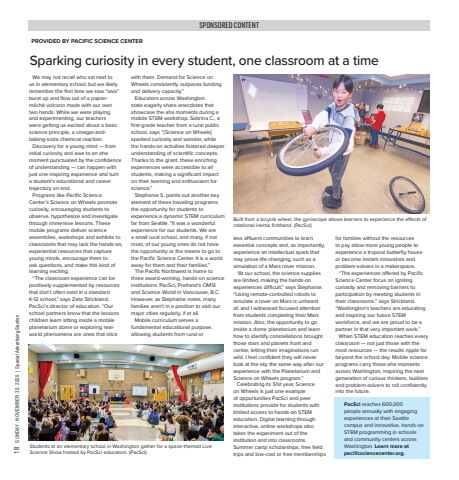
Sunday, November 30, 2025 | Special Advertising Section 18with them. Demand for Science onWheels consistently outpaces fundingand delivery capacity.%u201dEducators across Washingtonstate eagerly share anecdotes thatshowcase the aha moments during amobile STEM workshop. Sabrina C., a first-grade teacher from a rural publicschool, says %u201c[Science on Wheels]sparked curiosity and wonder, while the hands-on activities fostered deeperunderstanding of scientific concepts.Thanks to the grant, these enrichingexperiences were accessible to allstudents, making a significant impacton their learning and enthusiasm forscience.%u201dStephanie S. points out another keyelement of these traveling programs: the opportunity for students to experience a dynamic STEM curriculum far from Seattle. \experience for our students. We area small rural school, and many, if not most, of our young ones do not havethe opportunity or the means to go tothe Pacific Science Center. It is a world away for them and their families.%u201dThe Pacific Northwest is home tothree award-winning, hands-on science institutions: PacSci, Portland%u2019s OMSIand Science World in Vancouver, B.C. However, as Stephanie notes, many families aren't in a position to visit ourmajor cities regularly, if at all.Mobile curriculum serves afundamental educational purpose, allowing students from rural or less affluent communities to learnessential concepts and, as importantly,experience an intellectual spark thatmay prove life-changing, such as asimulation of a Mars rover mission.%u201cAt our school, the science suppliesare limited, making the hands-onexperiences difficult,%u201d says Stephanie. %u201cUsing remote-controlled robots tosimulate a rover on Mars is unheard of, and I witnessed focused attentionfrom students completing their Marsmission. Also, the opportunity to go inside a dome planetarium and learnhow to identify constellations broughtthose stars and planets front and center, letting their imaginations runwild. I feel confident they will never look at the sky the same way after ourexperience with the Planetarium and Science on Wheels program.%u201dCelebrating its 51st year, Scienceon Wheels is just one example of opportunities PacSci and peerinstitutions provide for students withlimited access to hands-on STEMeducation. Digital learning throughinteractive, online workshops alsotakes the experiment out of the institution and into classrooms.Summer camp scholarships, free fieldtrips and low-cost or free memberships SPONSORED CONTENTPROVIDED BY PACIFIC SCIENCE CENTERWe may not recall who sat next tous in elementary school, but we likelyremember the first time we saw %u201clava%u201d burst up and flow out of a papierm%u00e2ch%u00e9 volcano made with our owntwo hands. While we were playingand experimenting, our teacherswere getting us excited about a basicscience principle, a vinegar-andbaking-soda chemical reaction.Discovery for a young mind %u2014 from initial curiosity and awe to an ahamoment punctuated by the confidence of understanding %u2014 can happen with just one inspiring experience and turna student%u2019s educational and careertrajectory on end. Programs like Pacific ScienceCenter%u2019s Science on Wheels promote curiosity, encouraging students toobserve, hypothesize and investigatethrough immersive lessons. Thesemobile programs deliver scienceassemblies, workshops and exhibits toclassrooms that may lack the hands-on,experiential resources that capture young minds, encourage them toask questions, and make this kind of learning exciting. %u201cThe classroom experience can bepositively supplemented by resourcesthat don%u2019t often exist in a standard K-12 school,%u201d says Zeta Strickland,PacSci%u2019s director of education. %u201cOurschool partners know that the lessonschildren learn sitting inside a mobileplanetarium dome or exploring realworld phenomena are ones that stickSparking curiosity in every student, one classroom at a timePacSci reaches 600,000people annually with engaging experiences at their Seattle campus and innovative, hands-onSTEM programming in schools and community centers across Washington. Learn more at pacificsciencecenter.org.Students at an elementary school in Washington gather for a space-themed Live Science Show hosted by PacSci educators. (PacSci)Built from a bicycle wheel, the gyroscope allows learners to experience the effects of rotational inertia firsthand. (PacSci)for families without the resources to pay allow more young people toexperience a tropical butterfly house or become instant innovators and problem-solvers in a makerspace.%u201cThe experiences offered by PacificScience Center focus on ignitingcuriosity and removing barriers to participation by meeting students in their classrooms.%u201d says Strickland.%u201cWashington%u2019s teachers are educatingand inspiring our future STEMworkforce, and we are proud to be a partner in that very important work.%u201dWhen STEM education reaches everyclassroom %u2014 not just those with themost resources %u2014 the results ripple far beyond the school day. Mobile science programs carry those aha momentsacross Washington, inspiring the nextgeneration of curious thinkers, buildersand problem-solvers to roll confidently into the future.


