


Page 16 - Demo
P. 16
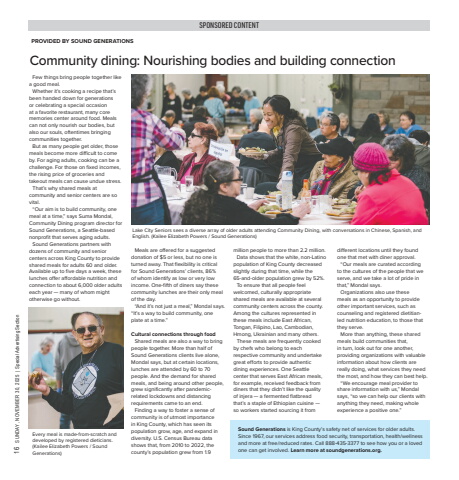
Sunday, November 30, 2025 | Special Advertising Section 16Meals are offered for a suggesteddonation of $5 or less, but no one isturned away. That flexibility is critical for Sound Generations%u2019 clients, 86% of whom identify as low or very lowincome. One-fifth of diners say these community lunches are their only meal of the day.%u201cAnd it%u2019s not just a meal,%u201d Mondal says.%u201cIt%u2019s a way to build community, one plate at a time.%u201dCultural connections through foodShared meals are also a way to bringpeople together. More than half ofSound Generations clients live alone,Mondal says, but at certain locations, lunches are attended by 60 to 70people. And the demand for sharedmeals, and being around other people, grew significantly after pandemicrelated lockdowns and distancingrequirements came to an end.Finding a way to foster a sense ofcommunity is of utmost importancein King County, which has seen itspopulation grow, age, and expand indiversity. U.S. Census Bureau datashows that, from 2010 to 2022, thecounty%u2019s population grew from 1.9 million people to more than 2.2 million.Data shows that the white, non-Latino population of King County decreased slightly during that time, while the65-and-older population grew by 52%.To ensure that all people feelwelcomed, culturally appropriate shared meals are available at several community centers across the county. Among the cultures represented inthese meals include East African, Tongan, Filipino, Lao, Cambodian,Hmong, Ukrainian and many others.These meals are frequently cookedby chefs who belong to eachrespective community and undertake great efforts to provide authentic dining experiences. One Seattlecenter that serves East African meals, for example, received feedback fromdiners that they didn%u2019t like the qualityof injera %u2014 a fermented flatbreadthat%u2019s a staple of Ethiopian cuisine %u2014so workers started sourcing it from SPONSORED CONTENTPROVIDED BY SOUND GENERATIONSFew things bring people together like a good meal.Whether it%u2019s cooking a recipe that%u2019s been handed down for generationsor celebrating a special occasionat a favorite restaurant, many corememories center around food. Meals can not only nourish our bodies, butalso our souls, oftentimes bringingcommunities together.But as many people get older, thosemeals become more difficult to comeby. For aging adults, cooking can be achallenge. For those on fixed incomes, the rising price of groceries andtakeout meals can cause undue stress.That%u2019s why shared meals atcommunity and senior centers are sovital.%u201cOur aim is to build community, onemeal at a time,%u201d says Suma Mondal, Community Dining program director forSound Generations, a Seattle-basednonprofit that serves aging adults.Sound Generations partners withdozens of community and seniorcenters across King County to provideshared meals for adults 60 and older. Available up to five days a week, these lunches offer affordable nutrition andconnection to about 6,000 older adults each year %u2014 many of whom mightotherwise go without.Community dining: Nourishing bodies and building connectionSound Generations is King County%u2019s safety net of services for older adults. Since 1967, our services address food security, transportation, health/wellness and more at free/reduced rates. Call 888-435-3377 to see how you or a loved one can get involved. Learn more at soundgenerations.org.Every meal is made-from-scratch and developed by registered dieticians.(Kailee Elizabeth Powers / Sound Generations)Lake City Seniors sees a diverse array of older adults attending Community Dining, with conversations in Chinese, Spanish, and English. (Kailee Elizabeth Powers / Sound Generations)different locations until they found one that met with diner approval.%u201cOur meals are curated according to the cultures of the people that we serve, and we take a lot of pride inthat,%u201d Mondal says.Organizations also use thesemeals as an opportunity to provide other important services, such ascounseling and registered dietitianled nutrition education, to those thatthey serve.More than anything, these shared meals build communities that,in turn, look out for one another, providing organizations with valuableinformation about how clients arereally doing, what services they needthe most, and how they can best help.%u201cWe encourage meal provider toshare information with us,%u201d Mondalsays, %u201cso we can help our clients with anything they need, making wholeexperience a positive one.%u201d


