


Page 12 - Demo
P. 12
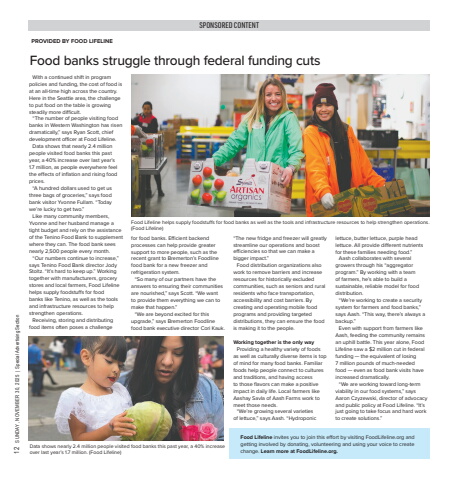
Sunday, November 30, 2025 | Special Advertising Section 12for food banks. Efficient backendprocesses can help provide greatersupport to more people, such as therecent grant to Bremerton%u2019s Foodlinefood bank for a new freezer andrefrigeration system.%u201cSo many of our partners have the answers to ensuring their communities are nourished,%u201d says Scott. %u201cWe want to provide them everything we can tomake that happen.%u201d%u201cWe are beyond excited for thisupgrade,%u201d says Bremerton Foodlinefood bank executive director Cori Kauk.%u201cThe new fridge and freezer will greatlystreamline our operations and boostefficiencies so that we can make abigger impact.%u201dFood distribution organizations also work to remove barriers and increaseresources for historically excludedcommunities, such as seniors and rural residents who face transportation,accessibility and cost barriers. Bycreating and operating mobile foodprograms and providing targeteddistributions, they can ensure the foodis making it to the people.Working together is the only wayProviding a healthy variety of foodsas well as culturally diverse items is topof mind for many food banks. Familiar foods help people connect to culturesand traditions, and having access to those flavors can make a positiveimpact in daily life. Local farmers like Aashay Savla of Aash Farms work to meet those needs.%u201cWe%u2019re growing several varietiesof lettuce,%u201d says Aash. %u201cHydroponicSPONSORED CONTENTPROVIDED BY FOOD LIFELINE With a continued shift in programpolicies and funding, the cost of food is at an all-time high across the country. Here in the Seattle area, the challengeto put food on the table is growing steadily more difficult.%u201cThe number of people visiting food banks in Western Washington has risendramatically,%u201d says Ryan Scott, chiefdevelopment officer at Food Lifeline.Data shows that nearly 2.4 million people visited food banks this past year, a 40% increase over last year%u2019s1.7 million, as people everywhere feelthe effects of inflation and rising food prices.%u201cA hundred dollars used to get usthree bags of groceries,%u201d says foodbank visitor Yvonne Fullam. %u201cTodaywe%u2019re lucky to get two.%u201dLike many community members, Yvonne and her husband manage atight budget and rely on the assistanceof the Tenino Food Bank to supplementwhere they can. The food bank seesnearly 2,500 people every month.%u201cOur numbers continue to increase,%u201dsays Tenino Food Bank director Jody Stoltz. %u201cIt%u2019s hard to keep up.%u201d Workingtogether with manufacturers, grocerystores and local farmers, Food Lifelinehelps supply foodstuffs for food banks like Tenino, as well as the toolsand infrastructure resources to helpstrengthen operations.Receiving, storing and distributingfood items often poses a challengeFood banks struggle through federal funding cutsFood Lifeline invites you to join this efort by visiting FoodLifeline.org and getting involved by donating, volunteering and using your voice to createchange. Learn more at FoodLifeline.org. Data shows nearly 2.4 million people visited food banks this past year, a 40% increase over last year%u2019s 1.7 million. (Food Lifeline)Food Lifeline helps supply foodstuffs for food banks as well as the tools and infrastructure resources to help strengthen operations. (Food Lifeline)lettuce, butter lettuce, purple head lettuce. All provide different nutrientsfor these families needing food.%u201dAash collaborates with severalgrowers through his %u201caggregator program.%u201d By working with a teamof farmers, he%u2019s able to build asustainable, reliable model for food distribution.%u201cWe%u2019re working to create a securitysystem for farmers and food banks,%u201d says Aash. %u201cThis way, there%u2019s always abackup.%u201dEven with support from farmers likeAash, feeding the community remainsan uphill battle. This year alone, FoodLifeline saw a $2 million cut in federal funding %u2014 the equivalent of losing 7 million pounds of much-needed food %u2014 even as food bank visits haveincreased dramatically.%u201cWe are working toward long-termviability in our food systems,%u201d says Aaron Czyzewski, director of advocacyand public policy at Food Lifeline. %u201cIt%u2019s just going to take focus and hard workto create solutions.%u201d


