


Page 30 - Demo
P. 30
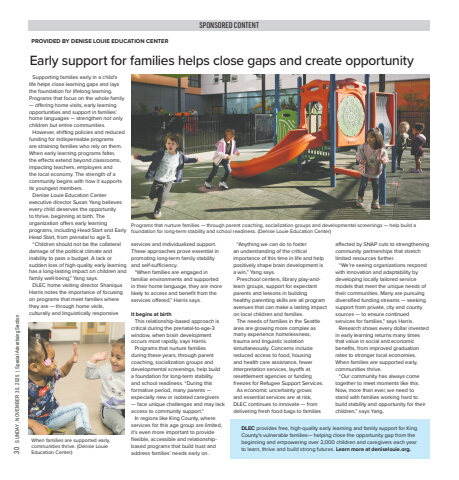
Sunday, November 30, 2025 | Special Advertising Section 30services and individualized support.These approaches prove essential inpromoting long-term family stability and self-sufficiency.%u201cWhen families are engaged infamiliar environments and supportedin their home language, they are morelikely to access and benefit from theservices offered,%u201d Harris says.It begins at birthThis relationship-based approach iscritical during the prenatal-to-age-3window, when brain development occurs most rapidly, says Harris.Programs that nurture familiesduring these years, through parent coaching, socialization groups anddevelopmental screenings, help builda foundation for long-term stabilityand school readiness. %u201cDuring thisformative period, many parents %u2014especially new or isolated caregivers%u2014 face unique challenges and may lackaccess to community support.%u201dIn regions like King County, where services for this age group are limited,it%u2019s even more important to provide flexible, accessible and relationshipbased programs that build trust andaddress families%u2019 needs early on.%u201cAnything we can do to fosteran understanding of the criticalimportance of this time in life and helppositively shape brain development is a win,%u201d Yang says.Preschool centers, library play-andlearn groups, support for expectant parents and lessons in buildinghealthy parenting skills are all programavenues that can make a lasting impacton local children and families.The needs of families in the Seattlearea are growing more complex asmany experience homelessness,trauma and linguistic isolation simultaneously. Concerns include reduced access to food, housing and health care assistance, fewerinterpretation services, layoffs atresettlement agencies or fundingfreezes for Refugee Support Services.As economic uncertainty growsand essential services are at risk,DLEC continues to innovate %u2014 fromdelivering fresh food bags to familiesSPONSORED CONTENTPROVIDED BY DENISE LOUIE EDUCATION CENTER Supporting families early in a child%u2019s life helps close learning gaps and laysthe foundation for lifelong learning.Programs that focus on the whole family%u2014 offering home visits, early learningopportunities and support in families%u2019 home languages %u2014 strengthen not only children but entire communities.However, shifting policies and reduced funding for indispensable programsare straining families who rely on them. When early learning programs falter, the effects extend beyond classrooms,impacting teachers, employers andthe local economy. The strength of acommunity begins with how it supportsits youngest members.Denise Louie Education Center executive director Susan Yang believes every child deserves the opportunityto thrive, beginning at birth. The organization offers early learningprograms, including Head Start and EarlyHead Start, from prenatal to age 5.%u201cChildren should not be the collateraldamage of the political climate andinability to pass a budget. A lack orsudden loss of high-quality early learninghas a long-lasting impact on children andfamily well-being,\DLEC home visiting director ShaniquaHarris notes the importance of focusingon programs that meet families where they are %u2014 through home visits,culturally and linguistically responsive Early support for families helps close gaps and create opportunityDLEC provides free, high-quality early learning and family support for King County's vulnerable families%u2014 helping close the opportunity gap from thebeginning and empowering over 2,000 children and caregivers each year to learn, thrive and build strong futures. Learn more at deniselouie.org.When families are supported early,communities thrive. (Denise Louie Education Center)Programs that nurture families %u2014 through parent coaching, socialization groups and developmental screenings %u2014 help build a foundation for long-term stability and school readiness. (Denise Louie Education Center)affected by SNAP cuts to strengtheningcommunity partnerships that stretchlimited resources further.%u201cWe%u2019re seeing organizations respond with innovation and adaptability bydeveloping locally tailored service models that meet the unique needs of their communities. Many are pursuingdiversified funding streams %u2014 seeking support from private, city and countysources %u2014 to ensure continuedservices for families,\Research shows every dollar invested in early learning returns many times that value in social and economicbenefits, from improved graduationrates to stronger local economies.When families are supported early, communities thrive.%u201cOur community has always cometogether to meet moments like this.Now, more than ever, we need tostand with families working hard tobuild stability and opportunity for theirchildren,%u201d says Yang.


