


Page 26 - Demo
P. 26
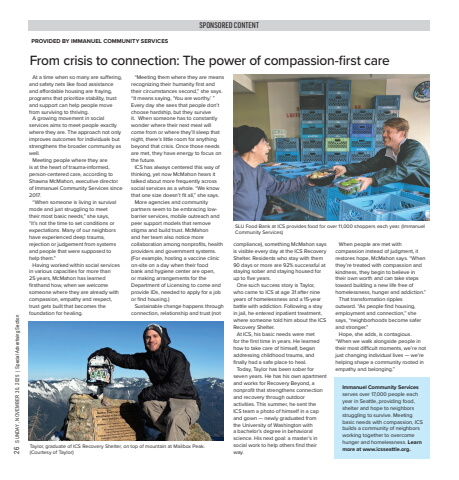
Sunday, November 30, 2025 | Special Advertising Section 26%u201cMeeting them where they are means recognizing their humanity first and their circumstances second,%u201d she says.%u201cIt means saying, %u2018You are worthy.%u2019 %u201dEvery day she sees that people don%u2019tchoose hardship, but they surviveit. When someone has to constantlywonder where their next meal will come from or where they%u2019ll sleep that night, there%u2019s little room for anythingbeyond that crisis. Once those needs are met, they have energy to focus onthe future.ICS has always centered this way of thinking, yet now McMahon hears it talked about more frequently across social services as a whole. %u201cWe knowthat one size doesn%u2019t fit all,%u201d she says.More agencies and communitypartners seem to be embracing lowbarrier services, mobile outreach and peer support models that removestigma and build trust. McMahon and her team also notice morecollaboration among nonprofits, healthproviders and government systems.(For example, hosting a vaccine clinicon-site on a day when their food bank and hygiene center are open, or making arrangements for theDepartment of Licensing to come andprovide IDs, needed to apply for a jobor find housing.) Sustainable change happens through connection, relationship and trust (notcompliance), something McMahon says is visible every day at the ICS Recovery Shelter. Residents who stay with them90 days or more are 92% successful atstaying sober and staying housed for up to five years. One such success story is Taylor,who came to ICS at age 31 after nineyears of homelessness and a 15-year battle with addiction. Following a stay in jail, he entered inpatient treatment,where someone told him about the ICS Recovery Shelter.At ICS, his basic needs were metfor the first time in years. He learnedhow to take care of himself, began addressing childhood trauma, and finally had a safe place to heal.Today, Taylor has been sober forseven years. He has his own apartmentand works for Recovery Beyond, anonprofit that strengthens connection and recovery through outdooractivities. This summer, he sent theICS team a photo of himself in a capand gown %u2014 newly graduated from the University of Washington witha bachelor%u2019s degree in behavioralscience. His next goal: a master%u2019s insocial work to help others find their way.SPONSORED CONTENTPROVIDED BY IMMANUEL COMMUNITY SERVICESAt a time when so many are suffering,and safety nets like food assistanceand affordable housing are fraying,programs that prioritize stability, trust and support can help people move from surviving to thriving.A growing movement in socialservices aims to meet people exactly where they are. The approach not only improves outcomes for individuals but strengthens the broader community aswell.Meeting people where they areis at the heart of trauma-informed, person-centered care, according toShawna McMahon, executive directorof Immanuel Community Services since 2017. %u201cWhen someone is living in survivalmode and just struggling to meettheir most basic needs,%u201d she says,%u201cit%u2019s not the time to set conditions orexpectations. Many of our neighborshave experienced deep trauma,rejection or judgement from systemsand people that were supposed tohelp them.%u201d Having worked within social servicesin various capacities for more than25 years, McMahon has learnedfirsthand how, when we welcomesomeone where they are already withcompassion, empathy and respect,trust gets built that becomes thefoundation for healing.From crisis to connection: The power of compassion-first careImmanuel Community Servicesserves over 17,000 people each year in Seattle, providing food, shelter and hope to neighborsstruggling to survive. Meetingbasic needs with compassion, ICS builds a community of neighbors working together to overcome hunger and homelessness. Learnmore at www.icsseattle.org.Taylor, graduate of ICS Recovery Shelter, on top of mountain at Mailbox Peak. (Courtesy of Taylor)SLU Food Bank at ICS provides food for over 11,000 shoppers each year. (ImmanuelCommunity Services)When people are met with compassion instead of judgment, it restores hope, McMahon says. %u201cWhenthey%u2019re treated with compassion andkindness, they begin to believe intheir own worth and can take steps toward building a new life free of homelessness, hunger and addiction.%u201dThat transformation ripples outward. %u201cAs people find housing,employment and connection,%u201d shesays, %u201cneighborhoods become saferand stronger.%u201dHope, she adds, is contagious.%u201cWhen we walk alongside people intheir most difficult moments, we%u2019re notjust changing individual lives %u2014 we%u2019re helping shape a community rooted inempathy and belonging.%u201d


