


Page 5 - Demo
P. 5
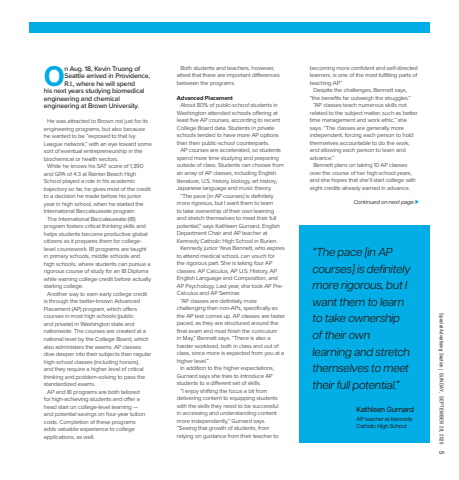
Special Advertising Section | Sunday, September 28, 2025 5On Aug. 18, Kevin Truong of Seattle arrived in Providence, R.I., where he will spend his next years studying biomedical engineering and chemical engineering at Brown University.He was attracted to Brown not just for its engineering programs, but also because he wanted to be %u201cexposed to that Ivy League network,%u201d with an eye toward some sort of eventual entrepreneurship in the biochemical or health sectors.While he knows his SAT score of 1,390 and GPA of 4.3 at Rainier Beach High School played a role in his academic trajectory so far, he gives most of the credit to a decision he made before his junior year in high school, when he started the International Baccalaureate program.The International Baccalaureate (IB) program fosters critical thinking skills and helps students become productive global citizens as it prepares them for collegelevel coursework. IB programs are taught in primary schools, middle schools and high schools, where students can pursue a rigorous course of study for an IB Diploma while earning college credit before actually starting college.Another way to earn early college credit is through the better-known Advanced Placement (AP) program, which offers courses in most high schools (public and private) in Washington state and nationwide. The courses are created at a national level by the College Board, which also administers the exams. AP classes dive deeper into their subjects than regular high-school classes (including honors), and they require a higher level of critical thinking and problem-solving to pass the standardized exams.AP and IB programs are both tailored for high-achieving students and offer a head start on college-level learning %u2014 and potential savings on four-year tuition costs. Completion of these programs adds valuable experience to college applications, as well. Both students and teachers, however, attest that there are important differences between the programs.Advanced PlacementAbout 80% of public-school students in Washington attended schools offering at least five AP courses, according to recent College Board data. Students in private schools tended to have more AP options than their public-school counterparts.AP courses are accelerated, so students spend more time studying and preparing outside of class. Students can choose from an array of AP classes, including English literature, U.S. history, biology, art history, Japanese language and music theory.%u201cThe pace [in AP courses] is definitely more rigorous, but I want them to learn to take ownership of their own learning and stretch themselves to meet their full potential,%u201d says Kathleen Gurnard, English Department Chair and AP teacher at Kennedy Catholic High School in Burien.Kennedy junior Yeva Bennett, who aspires to attend medical school, can vouch for the rigorous part. She is taking four AP classes: AP Calculus, AP U.S. History, AP English Language and Composition, and AP Psychology. Last year, she took AP PreCalculus and AP Seminar.%u00a0%u201cAP classes are definitely more challenging than non-APs, specifically as the AP test comes up. AP classes are faster paced, as they are structured around the final exam and must finish the curriculum in May,%u201d Bennett says. %u201cThere is also a harder workload, both in class and out of class, since more is expected from you at a higher level.%u201dIn addition to the higher expectations, Gurnard says she tries to introduce AP students to a different set of skills.%u201cI enjoy shifting the focus a bit from delivering content to equipping students with the skills they need to be successful in accessing and understanding content more independently,%u201d Gurnard says. %u201cSeeing that growth of students, from relying on guidance from their teacher to becoming more confident and self-directed learners, is one of the most fulfilling parts of teaching AP.%u201dDespite the challenges, Bennett says, %u201cthe benefits far outweigh the struggles.%u201d%u201cAP classes teach numerous skills not related to the subject matter, such as better time management and work ethic,%u201d she says. %u201cThe classes are generally more independent, forcing each person to hold themselves accountable to do the work, and allowing each person to learn and advance.%u201dBennett plans on taking 10 AP classes over the course of her high school years, and she hopes that she%u2019ll start college with eight credits already earned in advance.%u201cThe pace [in AP courses] is definitely more rigorous, but I want them to learn to take ownership of their own learning and stretch themselves to meet their full potential.%u201dKathleen GurnardAP teacher at Kennedy Catholic High SchoolContinued on next page


